
What the Research Says About OTC Hearing Aids and What’s Changed Since
By Kim Fishman, Audiologist | Hears Hearing & Hearables, Hopkins, Minnesota
Summarizing peer-reviewed research published in Frontiers in Audiology and Otology, March 2024. Authors: King Chung and Fan-Gang Zeng.
At Hears Hearing & Hearables, we stay current with what researchers are saying about hearing health, not just what manufacturers are marketing. In March 2024, a peer-reviewed article by King Chung and Fan-Gang Zeng was published in Frontiers in Audiology and Otology, examining the potential of over the counter hearing aids to transform global hearing care. It’s one of the more comprehensive academic overviews of the OTC market written since the FDA opened the category in 2022.
This post summarizes the key findings from that research, with a few important updates from us where the landscape has shifted since the paper was published, particularly around Apple’s entry into the hearing aid market, which the researchers noted had not yet happened at time of writing. If you’d like to read the full article, reach out and we’ll send you a copy.
For a broader context on the OTC market from our perspective as practitioners, see our post on how the OTC hearing aid market actually works.
The Global Scale of Hearing Loss; Why This Research Matters
1.6 billion people, approximately 20% of the world’s population, currently have some level of hearing loss. By 2050, that number is projected to reach 2.5 billion. (Chung & Zeng, Frontiers in Audiology and Otology, 2024)
Hearing loss is the third most common chronic health condition globally. It carries an estimated annual cost of US$1 trillion, the result of healthcare expenses, lost productivity, reduced educational attainment, and diminished quality of life. Hearing aids, which have existed in various forms for over a century, are one of the most effective interventions. Yet globally, the majority of people who need them don’t use them.
The reasons are familiar: cost, access, stigma, and the friction of navigating a healthcare system to get a prescription device. The FDA’s 2022 OTC hearing aid rule was designed to address at least the first two of those barriers and this research examines how well it’s working and where the challenges remain.
The OTC Hearing Aid Market: Who’s In It and What It Costs
Within approximately one year of the FDA opening the OTC category, over 100 companies had entered the market, the majority being startups from Asia. Established prescription hearing aid manufacturers, including Sonova, Demant, WS Audiology (Signia, Widex, Rexton), GN ReSound, and Starkey, also entered the OTC space alongside these newer players.
2024 UPDATE: At the time of the original research, the authors specifically noted that Apple and Google had not yet entered the OTC market ‘even though they have the technology.’ This has since changed. In October 2024, Apple launched FDA-cleared Hearing Aid software for AirPods Pro 2 via iOS 18.1, marking the entry of a major consumer electronics company into the OTC space that the researchers were anticipating. Read our full assessment of how the AirPods Pro 2 performs as a hearing aid.
On the cost side, the research highlights a significant gap between what OTC hearing aids actually cost and what consumers are willing to pay. A quality pair of OTC hearing aids at time of publication ranged from $800 to $3,000. Most consumers, however, indicated willingness to spend approximately $200, a figure the researchers noted is comparable to the price of Apple AirPods, which sold over 80 million units in 2022.
This price gap remains one of the most significant structural challenges in the OTC market. We’ve seen it in our own practice, patients are excited about OTC accessibility until they see pricing. The market has moved somewhat in the right direction since 2024, with strong devices like the ELEHEAR Delight launching at $369 and LINNER models available under $300, but the $200 sweet spot the research identifies has not yet been widely achieved at quality levels that deliver real benefit.
An Important Finding: OTC Devices Can Amplify Beyond What Most Users Need
One of the more surprising findings in the research involves the FDA’s output guidelines for OTC hearing aids. The FDA set limits on maximum output levels without restricting gain, meaning OTC devices can technically amplify sounds at levels sufficient even for severe or profound hearing loss, well beyond the mild-to-moderate range they’re designed and marketed for.
The researchers flag this as a double-edged finding. On one hand, it means OTC devices have more range than their marketing suggests. On the other, it creates a real risk of overamplification, particularly for users who assume more amplification is better and push their devices to maximum settings.
“While this might help more people, it also poses risks of overamplification. Both manufacturers and users need to be careful about excessive amplification.” — Chung & Zeng, 2024
This is exactly why we recommend professional guidance even for OTC purchases, not because you need a prescription, but because understanding your actual amplification needs helps you set up your device correctly rather than guessing.
Three Technologies Shaping the Future of OTC Hearing Aids
The research identifies three technology areas it expects to drive significant improvement in OTC hearing aid performance over the coming years. Looking at these through the lens of what’s happened in the market since publication is instructive.
1. Smartphones as Hearing Platforms
Researchers found that smartphones, with their powerful computing capabilities and similar output characteristics to OTC hearing aids, are increasingly capable of functioning as personalized hearing platforms when paired with the right earbuds and apps. By measuring a user’s hearing range with their specific earbud-smartphone combination, an app can adjust sound output to match individual hearing needs.
2024 UPDATE: This is precisely what Apple implemented with AirPods Pro 2. The iOS 18.1 Hearing Test uses the AirPods’ microphones with the iPhone to assess hearing across frequencies, then applies personalized amplification in real time. The research predicted this development; Apple delivered it. The limitation the researchers anticipated is that high price might prevent consumer electronics companies from making devices OTC-eligible turned out to be accurate for the AirPods Pro 2 at $249, though Apple’s market presence made that price point broadly accessible.
2. True Wireless Stereo (TWS) Earbud Technology
True Wireless Stereo earbuds represent a $51 billion market (as of 2022) projected to grow substantially through 2030. The research identifies three specific ways TWS technology improves OTC hearing aid performance: noise reduction algorithms that improve speech clarity in noisy environments, wireless microphone-to-earbud connections that improve sound quality, and advances in Bluetooth protocols (including LC3plus) that reduce audio latency, a critical factor for natural-sounding real-time hearing assistance.
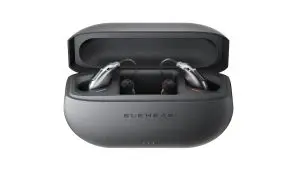
The convergence of TWS technology with hearing aid function is visible in devices like the ELEHEAR Beyond Pro, which uses Bluetooth 5.3 with 8ms latency, and the LINNER Nova Lite and Mars, which combine OTC hearing aid function with modern earbud form factors. The market has moved in exactly the direction the researchers anticipated.
3. Artificial Intelligence
The research notes that the FDA had approved over 170 AI-enabled medical devices at time of writing, and that AI-equipped hearing aids had been in development since 2018. The researchers identify AI as having particular potential for OTC hearing aids in two areas: analyzing and classifying sound environments automatically, and improving speech understanding in noisy settings, the single most common hearing challenge for people with mild to moderate loss.
This prediction has played out clearly in the current OTC market. ELEHEAR’s VOCCLEAR 2.0, which uses a deep neural network analyzing the environment 500 times per second and earned the Beyond Pro a #2 ranking out of 56 OTC devices in independent HearAdvisor testing is a direct example of AI delivering on the potential the researchers described.
The Global Potential and the Remaining Barriers
Beyond the U.S. market, the research makes a case for OTC hearing aids as a global health intervention. The traditional pathway to hearing aids, multiple appointments with specialists, professional fitting, high device costs, is inaccessible to most of the world’s population with hearing loss, particularly in low-income countries with limited healthcare infrastructure.
OTC hearing aids, combined with tele-audiology services and AI-powered self-fitting apps, could change that equation significantly. The researchers note that smartphones are already widely distributed globally, making a smartphone-based hearing aid platform potentially the most scalable hearing health intervention ever developed.
The barriers that remain are real: price (the $200 gap is even more significant in lower-income markets), regulatory frameworks outside the U.S., and the need for continued technical innovation to improve performance at accessible price points. But the research frames OTC hearing aids as a genuine opportunity to address what has been called one of the most underserved global health challenges.
Two Outcomes That May Matter Most: Stigma Reduction and Cognitive Health
Reducing the Stigma of Hearing Aids
One of the consistent barriers to hearing aid adoption is stigma, the reluctance to be seen wearing a device associated with aging or disability. The research notes that OTC hearing aids, particularly those designed to look like consumer earbuds, may help normalize hearing assistance in ways traditional hearing aids haven’t.
Younger users , who are more likely to adopt OTC devices first, are also more likely to wear earbuds as a routine part of daily life. The overlap between OTC hearing devices and everyday tech accessories reduces the visible social signal of hearing loss, which the researchers suggest could meaningfully increase adoption rates over time.
Hearing Loss, Cognitive Decline, and Dementia Risk
Approximately 40% of dementia risk factors are modifiable. Midlife hearing loss is identified as one of the most significant. Research suggests that using hearing aids may help slow cognitive decline and reduce dementia risk, particularly in people at elevated risk.
This is one of the most clinically significant findings in the paper. While the causal relationship between hearing loss and dementia is still being studied, it isn’t definitively established that hearing loss directly causes dementia, the correlation is strong enough that early intervention is considered prudent.
The researchers note that OTC hearing aids target a younger demographic (adults with mild-to-moderate loss who haven’t yet reached the point of prescription devices). Helping this group address hearing loss earlier than they otherwise would, at a lower cost and with less friction, could have significant long-term cognitive health benefits. The researchers describe this as potentially “one of the most important impacts of OTC hearing aids.”
This finding reinforces something we say regularly at Hears Hearing & Hearables: the biggest cost of untreated hearing loss isn’t the price of the hearing aid you didn’t buy. It’s the compounding cost of years of hearing loss on your brain, your relationships, and your cognitive reserve.
Key Conclusions From the Research
Chung and Zeng summarize their findings in six points. Here they are with our current-state commentary:
- Traditional manufacturers dominate. Established prescription hearing aid companies have dominated the OTC market, with limited disruption from consumer electronics or startups, though Apple’s 2024 entry may begin to shift this dynamic.
- OTC devices can amplify beyond mild-moderate needs. Without gain restrictions, OTC devices can provide amplification adequate for severe-to-profound loss, creating both opportunity and overamplification risk. Professional guidance on appropriate settings remains valuable.
- Customized innovation is still needed. Technology tailored specifically to mild-to-moderate hearing loss, rather than simply scaled-down prescription technology, remains an important development area.
- Smartphones and TWS earbuds are the delivery platform. The convergence of hearing aid function with consumer earbuds is well underway and represents the most scalable global access pathway.
- AI will enhance OTC performance. Already happening, devices like the ELEHEAR Beyond Pro demonstrate what AI-driven sound processing delivers at OTC price points.
- Younger adoption could reduce cognitive decline and stigma. The long-term cognitive health case for OTC hearing aids addressing earlier-stage hearing loss in younger adults is compelling and warrants attention from both individuals and public health systems.
What This Means for You
The research makes a clear case: OTC hearing aids represent a meaningful public health opportunity, particularly for people with mild-to-moderate hearing loss who have been putting off getting help because of cost or access barriers. The technology is improving rapidly. The price is coming down. And the potential benefits, beyond just hearing better, extend to cognitive health, social connection, and quality of life.
If you’ve been on the fence about whether to try an OTC hearing aid, this research suggests the sooner the better. Take our free Hearing Handicap Screening Test as a starting point, browse our current OTC selection, or reach out to our team for a personalized recommendation.
And if you’d like to read the full Chung and Zeng article from Frontiers in Audiology and Otology, contact us and we’ll send you a copy.
— Kim Fishman, Audiologist | Hears Hearing & Hearables, Hopkins, Minnesota