
Sony OTC Hearing Aids (CRE-C10/20 & CRE-E10): A Review– and What to Buy Instead
When WS Audiology, the hearing health giant behind Widex and Signia, partnered with Sony to create over-the-counter hearing aids, it turned a lot of heads. Two models launched: the Sony CRE-C10 and the Sony CRE-E10. Both were built on real hearing aid technology, offered genuine self-fit capability through the Sony Hearing Control app, and came with the kind of brand recognition that made OTC hearing aids feel approachable to first-time buyers.
They were good products. And then they were gone, out of stock for the undefined future.
This post covers what made the Sony OTC hearing aids worth considering, how they compared to each other, and most importantly, what we recommend for anyone who was looking at them and now needs an alternative. We’ve been involved in developing one of those alternatives directly, and we’ll walk you through both options.
Why the Sony + WS Audiology Partnership Mattered
The collaboration between Sony and WS Audiology wasn’t just a marketing exercise. WS Audiology manufactures Widex and Signia hearing aids, two of the most respected brands in prescription hearing care. Bringing that underlying technology platform to an OTC price point, distributed under a consumer electronics brand most people already trusted, was a meaningful move for the market.
Both Sony OTC models included core features that set them apart from lower-end amplifiers: a legitimate self-fit hearing assessment via the Sony Hearing Control app, directionality (the ability to focus on sound from a specific direction), a Speech/Noise management system to improve clarity in background noise, and impact noise protection to guard against sudden loud sounds. These were real hearing aid features, not just amplification.
Sony CRE-C10: The Invisible Option
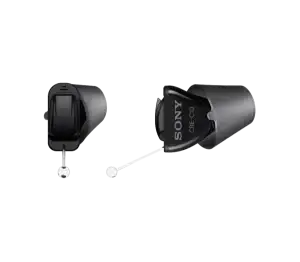
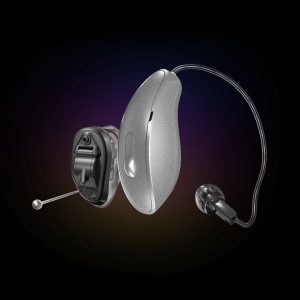
The CRE-C10 was a completely-in-canal (CIC) device, essentially invisible when worn. For first-time hearing aid users who felt self-conscious about visible devices, this was a significant appeal.
- Style: Completely-in-canal (CIC) — invisible in most ears
- Battery: Size 10 disposable — over 70 hours of continuous use per battery
- App control: Sony Hearing Control app for self-fit assessment, volume, and sound adjustments
- Technology: Noise reduction, automatic environment-based sound adjustments, app-based controls
- Bluetooth: None
- Best for: Adults with mild to moderate hearing loss who prioritize discretion
The tradeoff: no Bluetooth streaming and no rechargeable option. For users who wanted to stream audio from their phone or avoid dealing with small disposable batteries, the CRE-C10 wasn’t the right fit. That’s where the CRE-E10 came in.
Sony CRE-C20: The Rechargeable Upgrade for Discretion-First Buyers
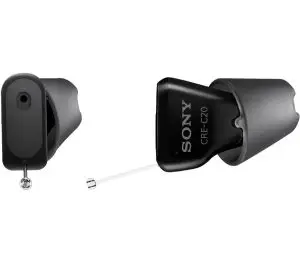
The CRE-C20 was Sony’s third OTC hearing aid, released after the CRE-C10 and CRE-E10, and represented the most significant upgrade to the invisible form factor. It kept the CRE-C10’s nearly identical, completely-in-canal design (measuring just 18mm long and weighing approximately 1 gram) while solving its biggest drawback: battery management.
- Style: Completely-in-canal (CIC) — virtually invisible, nearly identical in size to CRE-C10
- Battery: Rechargeable — up to 28 hours continuous use on a single charge; charging case provides two additional full charges (84 hours total without AC power)
- Bluetooth: None — app control only
- App: Sony Hearing Control — compatible with both iOS and Android; settings now retained between sessions (a key improvement over CRE-C10)
- Features: Upgraded sound processing, improved noise reduction, directionality with Ear-to-Ear Wireless Link, Auto Sound Analyzer for environment-based adjustments, impact noise protection
- Durability: IP68 rated — dust and water resistant
- Fit: Four sizes of closed sleeves included; wax guards included
- Best for: Adults with mild to moderate hearing loss who want the CRE-C10’s invisibility without the hassle of disposable batteries
The CRE-C20 launched at $999 and was positioned as the premium invisible-style option in Sony’s lineup, priced between the discounted CRE-C10 ($799) and the Bluetooth-equipped CRE-E10 ($1,099). Independent lab testing at HearAdvisor found strong speech clarity performance, with above-average scores in both quiet and noisy environments. It was widely regarded as the best-sounding non-Bluetooth OTC in-ear hearing aid available at the time of its release.
Like the CRE-C10, the CRE-C20 did not support Bluetooth audio streaming, a trade-off made necessary by its compact size. For buyers who needed streaming from a phone or TV, the CRE-E10 remained the right choice.
Sony CRE-E10: The Connected Option
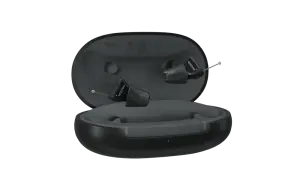
The CRE-E10 traded invisibility for connectivity. Larger and more visible, held in place with small click sleeves, it offered rechargeable batteries, Bluetooth streaming, and a charging case.
- Style: In-ear with click sleeves; more visible than CRE-C10/C20
- Battery: Rechargeable — 26 hours of continuous use; comes with charging case
- Bluetooth: Yes — streaming from iOS devices (Apple iPhone)
- App control: Sony Hearing Control app for self-fit and personalization
- Fit: Multiple dome sizes included for different ear shapes
- Best for: Adults with mild to mild-moderate hearing loss who want Bluetooth and rechargeable convenience
Worth noting: both Sony models were designed to be sold as either OTC self-fit devices or as professionally fit prescription hearing aids, the same underlying platform, different distribution paths. That dual-track design was forward-thinking, and it’s part of why the technology lives on in the alternatives we recommend below.
Sony OTC Hearing Aid Comparison: CRE-C10 vs. CRE-C20 vs. CRE-E10
| Feature | CRE-C10 | CRE-C20 | CRE-E10 |
| Style | CIC (invisible) | CIC (invisible) | In-ear with click sleeves (visible) |
| Battery | Size 10 disposable (70+ hrs) | Rechargeable (28 hrs) | Rechargeable (26 hrs) |
| Charging case | No | Yes (+2 full charges) | Yes |
| Bluetooth | No | No | Yes — iOS only |
| App compatibility | iOS & Android | iOS & Android | iOS & Android |
| Settings retained | No (temporary) | Yes (persistent) | Yes |
| IP rating | Not specified | IP68 | Not specified |
| Hearing loss range | Mild to moderate | Mild to moderate | Mild to mild-moderate |
| Original price | $999 → $799 | $999 | $1,299 → $1,099 |
| Return window | 45 days (Sony direct) | 45 days (Sony direct) | 45 days (Sony direct) |
| Status | DISCONTINUED | DISCONTINUED | DISCONTINUED |
Why Are All Three Sony OTC Hearing Aids Out-Of-Stock?
Sony hasn’t published a detailed public explanation. What we can say is that the OTC hearing aid market has evolved rapidly and competitively since these models launched. The underlying WS Audiology platform, Signia, Widex, and Rexton, has continued to advance, and that technology now powers more capable professionally fit devices. We were able to provide an alternative specifically for customers who have been looking at the Sony OTC lineup, and both carry forward the same technology lineage with expanded capability.
The Best Alternatives to the Sony OTC Hearing Aids
Both alternatives below require a professional fitting as they are prescription hearing aids, not OTC. That means a step up in both process and performance. If you were considering the Sony OTC models specifically because you wanted to avoid a fitting appointment, read our guide on what professionally fit hearing aids actually involve; it may be more accessible than you expect. [LINK to Blog 4: Professionally Fit Hearing Aids]
Alternative to Sony CRE-C10: Rexton INOX 40
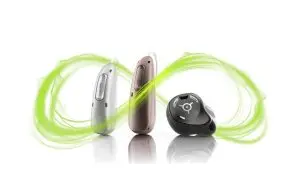
The Rexton INOX 40 is our recommended alternative for customers who loved the CRE-C10’s discreet, invisible-in-canal design. Like the CRE-C10, it prioritizes a small, low-profile form factor, but as a professionally fit device, it offers more precise customization to your hearing profile.
View the Rexton INOX 40 on our site:
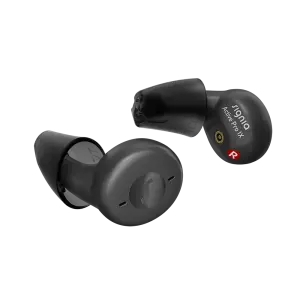
Alternative to Sony CRE-E10: Signia Active Pro IX
The Signia Active Pro IX is our recommended alternative for customers drawn to the CRE-E10’s Bluetooth connectivity and rechargeable convenience. Built on the same Signia platform as the WS Audiology / Sony collaboration, it brings forward that technology in a professionally fit form with significantly expanded features — including Bluetooth streaming to both iOS and Android, more advanced noise management, and Signia’s own fitting software for precise customization.
View the Signia Active Pro IX on our site:
Both alternatives require a professional fitting, which means working with one of our audiologists or hearing care professionals to get the device programmed to your individual hearing profile. Not sure if that’s right for you? Take our free Hearing Handicap Screening Test as a first step, or reach out and we’ll help you figure out the best path.
Still Exploring OTC Options? We Can Help.
If you came here looking for the Sony OTC hearing aids and aren’t sure the prescription route is what you want right now, we understand. There are still strong OTC options on the market. Our guide to choosing the best OTC hearing aid for your needs walks through all the key features to evaluate, and our team is happy to give you a personalized recommendation.
Browse our current hearing aid selection or contact us directly; we’re here to help you find what works.
Frequently Asked Questions: Sony OTC Hearing Aids
Are the Sony CRE-C10, CRE-C20, and CRE-E10 still available?
No. All three Sony OTC hearing aids are out of stock. We recommend the Rexton INOX 40 as an alternative to the CRE-C10 and CRE-C20, and the Signia Active Pro IX as an alternative to the CRE-E10. Both are built on the same WS Audiology technology platform.
What is the difference between the Sony CRE-C10 and CRE-C20?
Both are completely-in-canal (CIC) invisible hearing aids, but the CRE-C20 is an upgraded version. The CRE-C10 uses size 10 disposable batteries (70+ hours); the CRE-C20 has a rechargeable battery (28 hours per charge, with a charging case providing two additional charges). The CRE-C20 also has improved sound processing, persistent app settings, IP68 water resistance, and included wax guards. Neither model supports Bluetooth streaming.
Did the Sony CRE-C20 have Bluetooth?
No. The Sony CRE-C20 did not support Bluetooth audio streaming due to its compact completely-in-canal design. For Bluetooth streaming, the Sony CRE-E10 was the model in the lineup — though it is also now discontinued.
What was the Sony CRE-C20 price?
The Sony CRE-C20 launched at $999. It was positioned as the mid-range premium option in Sony’s OTC lineup, between the out-of-stock CRE-C10 at $799 and the CRE-E10 at $1,099.
What is the best alternative to the Sony CRE-C20?
We recommend the Rexton INOX 40 as the closest alternative to the Sony CRE-C20. It maintains a discreet in-canal form factor on the same WS Audiology technology platform, with the added benefit of professional fitting and custom programming to your individual hearing profile.