Bluetooth Hearing Aids: The Complete History From 1994 to Auracast
I first heard the word Bluetooth from a patient. He had profound hearing loss in one ear and functional hearing in the other, and he was asking about a BiCros hearing aid system. He wanted to know: why couldn’t they use Bluetooth for this? The term meant absolutely nothing to me at that moment. It reminded me of how a friend in the 1990s had tried to explain the information superhighway to me and I could not quite picture what it meant.
That conversation happened in the mid-1990s. I was working as a clinical audiologist in an Ear, Nose, and Throat specialist’s office. We had digitally programmable hearing aids but not digital ones. The iPod did not exist. Flip phones were cutting edge. BlackBerry had not yet appeared. And Bluetooth was a foreign word from a patient who saw a future I could not yet imagine.
Thirty years later, Bluetooth is the central connectivity technology of the hearing aid industry, and it is changing faster than at any previous point in its history. Here is the complete story.
1994 to 2009: The Origins of Bluetooth and Its First Hearing Aid Applications
Bluetooth technology was first conceived in 1994 by Ericsson, a Swedish communications company. The initial goal was simple: create a wireless alternative to RS-232 data cables connecting devices at close range. The name came from Harald Bluetooth, a tenth-century Danish king who united warring tribes, an apt metaphor for a technology designed to connect disparate devices.
The Bluetooth Special Interest Group (SIG) was founded in 1998 by Ericsson, Nokia, IBM, Toshiba, and Intel, and the first consumer Bluetooth devices appeared around 2000. For most of the early 2000s, hearing aid manufacturers connected to Bluetooth through accessory streamers: small devices worn around the neck or clipped to clothing that received audio from Bluetooth-enabled phones and retransmitted it to the hearing aids via a proprietary radio signal.
These streamers worked, but they added a device, added complexity, and added something visible around the user’s neck. The quest was always for a direct connection without the intermediary.
2010 to 2013: Bluetooth Low Energy Changes Everything
In 2010, Bluetooth Low Energy (LE) was introduced as part of the Bluetooth 4.0 specification. This was a genuinely significant development for hearing aids specifically. Standard Bluetooth was too power-hungry for a device that needed to last 16 or more hours on a tiny battery while sitting behind someone’s ear. Bluetooth LE used a fraction of the power while maintaining connectivity, making direct streaming to hearing aids technically feasible for the first time.
Hearing aid manufacturers began building Bluetooth LE into their devices, and the accessories started to shrink. The streamer still existed in many systems, but the groundwork for direct phone-to-hearing-aid connectivity was being laid.
2014: Apple Creates MFi and Changes the Market
In 2014, Apple introduced Made for iPhone (MFi) connectivity for hearing aids, a proprietary low-energy Bluetooth specification that allowed hearing aids to connect directly to iPhones without a streaming accessory. This was a landmark moment. For the first time, a hearing aid user could stream phone calls, music, and media directly from their iPhone to both hearing aids simultaneously.
The top manufacturers that adopted Apple’s MFi specification include GN ReSound, Signia, Widex, Starkey, and Oticon. Each paid licensing fees to Apple for the right to use the specification. Phonak took a different path, as we will discuss shortly.
Pairing to the iPhone in those early days required going into Settings, then Accessibility, then finding the MFi section, opening and closing the hearing aid battery doors to trigger pairing mode, and waiting for the aids to appear. It worked, but it was not simple. Over the years, both Apple and the hearing aid manufacturers refined the process considerably. The MFi section is now simply labeled Hearing Devices, and pairing has become genuinely straightforward for most users.
2017 to 2018: Phonak Goes Its Own Way, The SWORD Chip
While other manufacturers paid Apple’s licensing fees and built MFi into their devices, Phonak made a different strategic decision. In 2017 and 2018, they developed their own proprietary Bluetooth chip called SWORD (Sonova Wireless One Radio Digital), which connected to Bluetooth devices directly using standard Bluetooth Classic rather than the Low Energy Apple specification.
This approach gave Phonak several specific advantages. They avoided Apple’s licensing fees entirely. They could connect to virtually any Bluetooth device: iPhone, Android, Windows, Mac, televisions, computers, without depending on any proprietary standard. And critically, they were able to support hands-free calling, where the hearing aid microphone picks up the user’s voice during calls, rather than requiring the phone to be held near the mouth.
Now on version 3.0, the SWORD chip remains Phonak’s connectivity signature. It is why Phonak consistently leads in Android compatibility and why their universal device connectivity is genuinely distinctive in the market.
2018 to 2020: Android Gets ASHA
For Android users, direct hearing aid connectivity took longer to arrive. Android phones did not have a proprietary low-energy Bluetooth specification for hearing aids, and hearing aid manufacturers filled the gap with manufacturer-specific workarounds.
GN ReSound worked directly with Google to develop a solution, impatient with the pace of the Bluetooth SIG. The result, released with Android 10 and Bluetooth 5.0, was ASHA: Audio Streaming for Hearing Aids. ASHA allowed direct streaming from compatible Android phones to hearing aids without an accessory device.
By 2020, the major manufacturers supporting ASHA included GN ReSound, Signia, Starkey, and Widex. At that time, Oticon still did not have Android ASHA connectivity. That has since changed: Oticon now supports Android streaming on current platforms, a significant update from what was true when our earlier Bluetooth blog was written.
2021 to 2022: Bluetooth 5.2, LE Audio, and the Foundation for Auracast
The most consequential development in Bluetooth’s history for hearing aids arrived with Bluetooth 5.2 and the LE Audio specification. Previous Bluetooth LE used the SBC codec for audio compression. LE Audio introduced the LC3 codec, which delivers significantly better audio quality at lower bitrates and lower power consumption than its predecessor.
For hearing aids, LC3 meant: better sound quality during streaming, longer battery life during use, and the technical foundation for a new broadcast capability that would be called Auracast. The Bluetooth SIG’s vision was ambitious: an open standard that would let any Bluetooth LE Audio device receive audio from any compatible transmitter, without pairing, the way a radio receives a broadcast.
Bluetooth 5.3, released in July 2021, refined the specification further: improved channel classification to avoid congested radio frequencies, reduced connections for low-latency applications, better energy efficiency, and enhanced security. It began appearing in consumer devices in late 2021 and 2022.
2023 to 2025: Auracast Arrives in Hearing Aids
ReSound Nexia became the first hearing aid to activate Auracast functionality in 2023, followed by the Jabra Enhance Pro 20. These were not theoretical announcements; both devices could actually connect to Auracast transmitters and receive broadcast audio in real-world situations.
In 2025, ReSound launched the Vivia, which took Auracast further with the first dedicated Auracast Assistant built into the companion app, making it easy for users to find and connect to available Auracast broadcasts in public spaces.
Starkey activated Auracast on the Edge AI platform, and their Omega AI launched with Auracast compatibility built in. Oticon activated Auracast on the Intent platform via firmware update. The hearing aid industry moved from Auracast being a future promise to Auracast being a present reality over the course of roughly two years.
Where Bluetooth in Hearing Aids Is Heading
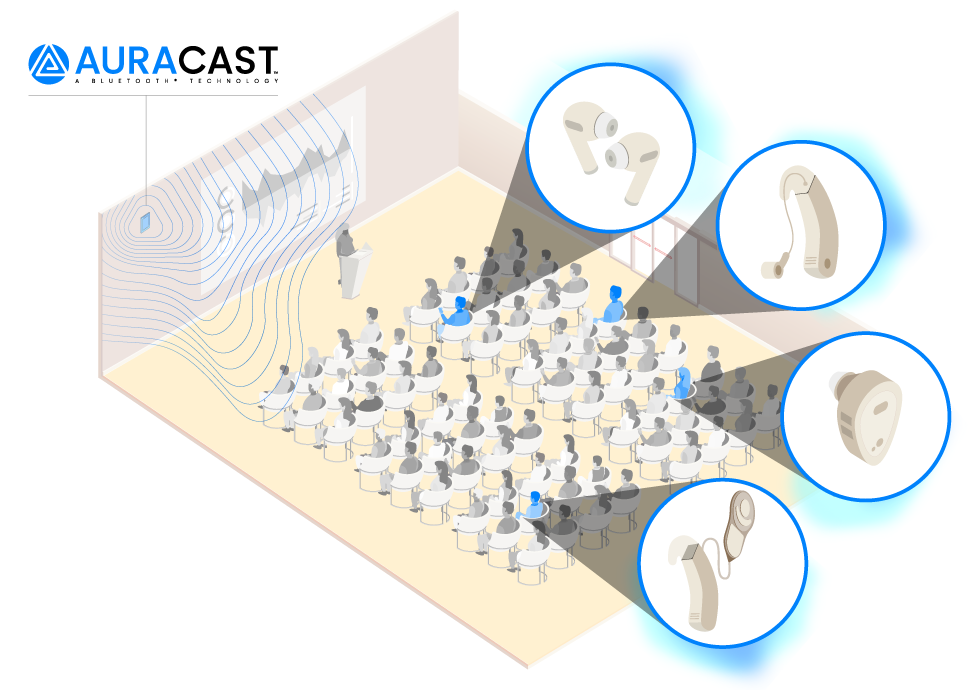
The direction is clear even if the timeline is not. Auracast infrastructure is beginning to appear in public venues: airports, places of worship, lecture halls, and entertainment venues. As that infrastructure grows, the value of having Auracast-enabled hearing aids grows with it. A hearing aid user in an Auracast-equipped theater will receive audio directly in their hearing aids at their preferred volume without disturbing anyone around them.
Apple has not yet embraced Auracast in AirPods, which has slowed public venue adoption. When Apple moves, which most observers expect eventually, public Auracast deployment will accelerate substantially.
Phonak’s position is the most interesting to watch. Their SWORD chip Bluetooth Classic approach maintains real competitive advantages in universal connectivity and hands-free calling. Whether they activate Auracast on the Infinio hardware (which is technically capable) or maintain their proprietary approach as a differentiator is one of the more consequential decisions in hearing aid connectivity over the next few years.
Frequently Asked Questions: Bluetooth Hearing Aids History
When did Bluetooth first appear in hearing aids?
The first Bluetooth-enabled hearing aids appeared in the mid-2000s, connecting through accessory streamers rather than directly. Direct phone-to-hearing-aid streaming without accessories became possible in 2014 when Apple introduced the Made for iPhone (MFi) specification that allowed hearing aids to connect directly to iPhones. Android direct streaming followed with ASHA in 2020.
What is Made for iPhone (MFi) and which hearing aids use it?
Made for iPhone is Apple’s proprietary low-energy Bluetooth specification for hearing aids, introduced in 2014. It allows compatible hearing aids to stream audio directly from iPhones without an accessory device. The major manufacturers that use MFi include GN ReSound, Signia, Widex, Starkey, and Oticon. Phonak uses their own proprietary SWORD chip instead of MFi.
What is ASHA, and which hearing aids support it?
ASHA (Audio Streaming for Hearing Aids) is Google’s Android hearing aid streaming protocol, available on Android 10 and higher with Bluetooth 5.0 or higher. It allows direct streaming from compatible Android phones to hearing aids without an accessory. All major hearing aid brands now support ASHA on current platforms, including Oticon, which did not support it on earlier models.
What makes Phonak’s Bluetooth different from other brands?
Phonak uses its proprietary SWORD (Sonova Wireless One Radio Digital) chip, now on version 3.0, which connects via standard Bluetooth Classic rather than the Low Energy Apple MFi specification. This gives Phonak universal device compatibility, iPhone, Android, Windows, Mac, televisions, and computers, without depending on any proprietary standard, and supports hands-free calling where the hearing aid microphone picks up the user’s voice. Phonak avoided Apple’s MFi licensing fees by developing its own solution.
 Technology Levels: