Your Ears Are Basically Tiny Miracle Workers. Let’s Give Them Some Credit.
You wake up in the morning. A bird chirps softly outside your window. Gentle. Pleasant. You shuffle to the kitchen, and someone slams a cabinet door. You nearly fall out of your slippers.
Same ears. Completely different experience.
How does that work? How does the same biological equipment handle a feather landing on a pillow and a motorcycle backfiring in a parking garage? The answer lies in one of the most elegant pieces of engineering in the human body, your cochlea, and a process called dynamic range compression.
Buckle up. This is going to be educational, occasionally weird, and at least mildly entertaining.
First, Let’s Talk About Sound Levels (Without Making Your Eyes Glaze Over)
Sound is measured in decibels (dB). Here is a quick gut-check on what that actually means in the real world:
- 0 dB: The absolute quietest sound a healthy human ear can detect. Think: a single mosquito deciding whether or not to bother you. I once had a patient tell me should could hear a flea fart. At 0 dB is quite an accomplishment for a hearing aid, if even possible!
- 30 dB: A soft whisper. Library-level quiet.
- 60 dB: Normal conversation. Two people talking about whether it’s too cold to go outside (a very common Minnesota conversation topic, for the record).
- 85 dB: Heavy traffic. The level at which prolonged exposure begins to cause hearing damage.
- 110 dB: A live rock concert. Or a New Yorker telling you about their commute.
- 140 dB: A jet engine at close range. Also, possibly the volume at which a New Yorker tells you that your pizza order was wrong.
The human ear can perceive sounds across a range of roughly 140 decibels from softest to loudest. That is an almost incomprehensibly wide range, and your ears manage it automatically, continuously, and without you ever thinking about it.
The Cochlea: Nature’s Most Underappreciated Compressor
Here is where things get genuinely fascinating.
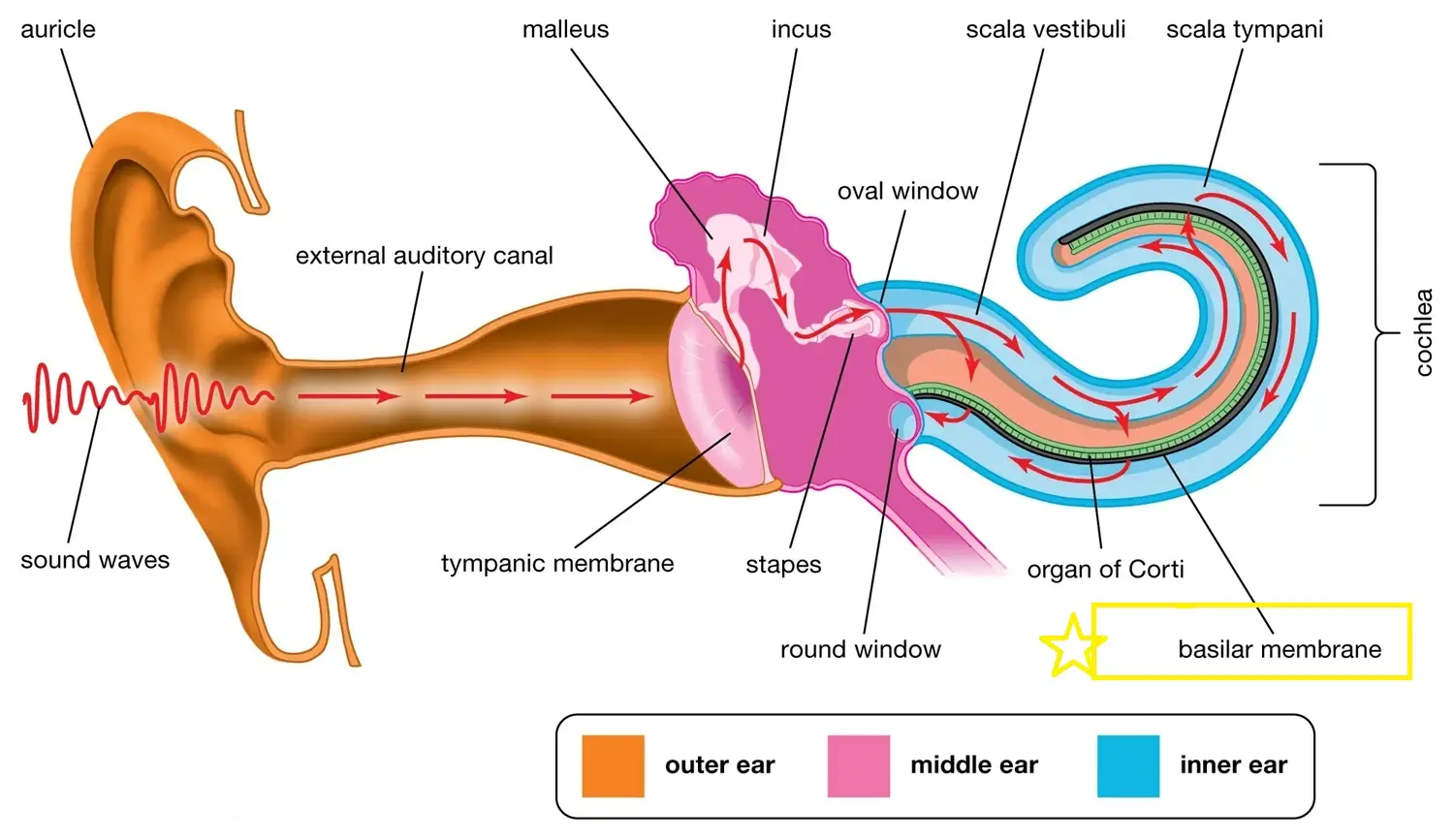
Inside your inner ear sits the cochlea. The cochlea is a fluid-filled, snail-shaped structure about the size of a pea. It is arguably the most sophisticated sound processor ever built, and it has been refined over roughly 300 million years of evolutionary engineering, which puts even the most advanced hearing aid chip to shame (though we are catching up).
The cochlea’s job is to take incoming sound waves and convert them into electrical signals that your brain can interpret. But it does not do this in a simple, linear way. It does something much cleverer: it compresses the dynamic range of sound.
Think of it like this. Imagine you are trying to take a photograph of a scene with both a very bright sky and a very dark shadow. A basic camera either blows out the sky or leaves the shadow completely black. A sophisticated camera applies dynamic range compression as it simultaneously pulls the highlights down and the shadows up, so you can see detail across the whole image.
Your cochlea does exactly this with sound. Soft sounds get a boost. Loud sounds get gently reined in. The result is that your brain receives a manageable, detailed signal representing the full range of what your ears picked up… from a whispered secret to a thunderclap.
The Outer Hair Cells: The Cochlea’s Secret Weapon
The real heroes of this story are structures inside the cochlea called outer hair cells. These tiny hair cells are responsible for most of the cochlea’s extraordinary dynamic range.
Here is how they work. When a soft sound enters the cochlea, the outer hair cells actively amplify the vibration, boosting the signal so that even faint sounds register clearly. When a loud sound arrives, those same cells stiffen and reduce their amplification, acting as a built-in volume limiter. They are, in essence, a biological automatic gain control system, responding to incoming sound levels in real time.
This is why sensorineural hearing loss (the most common type of hearing loss) caused by damage to these outer hair cells, does not simply make everything sound quieter. It actually collapses the dynamic range. Soft sounds become inaudible. But loud sounds can still feel uncomfortably intense, or even painful. This phenomenon, called loudness recruitment, is why people with hearing loss often say “I can hear you, I just can’t understand you” and also why simply turning up the volume on a television does not actually solve the problem. My friend, who has a PhD in Physics, studies the basilar membrane system at the University of Minnesota, and we joke about getting stuck on the basilar membrane and not focusing on the brain. The basilar membrane (the cochlea) is indeed very fascinating in how it does its job to help us hear.
The Bark Scale Theory: Your Brain’s Frequency Filing System
If the cochlea’s compression was the only trick your auditory system had, it would already be impressive. But there is more.
Your cochlea also processes different frequencies (pitches) at different physical locations along its spiral length. High pitches activate the base of the cochlea. Low pitches activate the apex. This has to do partly because the anatomy of the basilar membrane is tighter at the base and more flaccid or loose at the apex. And crucially, the spacing between these frequency “zones” is not uniform. It follows what scientists call the Bark scale, a nonlinear frequency mapping that corresponds to the critical bandwidths of human hearing perception.
In plain English: your cochlea does not treat all frequencies equally. It devotes more processing “real estate” to the frequencies that matter most for understanding speech, roughly 500 Hz to 4,000 Hz, and less to the extremes. This is why you are better at distinguishing subtle differences in a human voice than in, say, a dog whistle.
This biological frequency mapping is exactly what inspired ReSound’s WARP compression technology, which replicates these same nonlinear band spacings in their hearing aid processors.
Minnesota Monotone vs. the New York Decibel Festival
Now, let’s take a moment to appreciate just how much dynamic range the human ear handles across different humans.
Consider the Minnesota Monotone voice.
If you have spent any time in the upper Midwest, you know exactly what this is. A Minnesotan can deliver virtually any piece of information, a medical diagnosis, a touchdown call, or breaking news about a blizzard in a calm, measured, gently undulating voice that barely strays more than 3 decibels in either direction. It is the vocal equivalent of a flat lake on a windless day. Peaceful. Reliable. Acoustically undemanding. Your cochlea barely has to break a sweat. You could wear the most basic hearing aid on earth or the most fancy, and still have difficulty understanding, because the loudness range is approximately the same as an NPR podcast hosted by a golden retriever.
“Oh sure, you betcha, the house is on fire, that’s not great.” .. 58 dB. Steady. Unflinching.
Now consider the New Yorker Voice.
A New Yorker communicates across what can only be described as a full concert hall dynamic range. A single conversation about whether to take the subway or a cab can swing from a conspiratorial 45 dB whisper to a full-volume 95 dB proclamation in less than four seconds. Emotions are not suggested, they are announced. Every sentence has a crescendo. Every point of emphasis lands like a timpani hit. The dynamic range of a single New Yorker ordering a sandwich puts the Minnesota State Fair loudspeaker system to shame.
“I’m just saying …and I’m NOT yelling.. but if you think the 4 train is reliable on a TUESDAY then you have CLEARLY neve…” A 94 dB. Rising and falling intonation.
Here is the remarkable thing: your ears handle both of these people perfectly. Whether you are sitting across from a Minnesotan delivering a weather report with the emotional intensity of a sleeping cat, or standing next to a New Yorker having feelings at full volume, your cochlea is quietly, automatically compressing and adjusting the incoming signal so your brain receives clear, intelligible, appropriately balanced audio. No manual adjustment required. No reaching for a dial.
That is the miracle of biological dynamic range compression. And frankly, it deserves more appreciation than it gets. Now keep in mind, we are writing this to be fun and simple, and so we are not mentioning the middle ear bones, those muscles, and the brain, which also play into this ability.
What Happens When the System Breaks Down
When those outer hair cells are damaged by noise exposure, aging, medications, or other factors, the elegant compression system described above begins to fail. Here is what that looks like in real life:
Soft sounds disappear.
Without the cochlea’s active amplification of quiet sounds, whispers, distant voices, and soft consonants like “s,” “f,” and “th” simply fall below the threshold of perception. Speech becomes muffled even when the volume feels adequate.
Loud sounds stay loud or feel even louder.
Because the natural limiting function of the outer hair cells is also reduced, loud sounds no longer get reined in the same way. This is loudness recruitment, and it is why hearing loss can feel paradoxical: too quiet and too loud at the same time.
Noise becomes overwhelming.
With a reduced dynamic range, the brain’s ability to pull a voice out of competing background noise is significantly diminished. A restaurant that a normal-hearing person finds merely lively becomes genuinely exhausting.
Music loses its richness. The subtle differences in volume and tone that give music its emotional texture are compressed into a narrower, flatter experience.
How Modern Hearing Aids Try to Restore What Was Lost
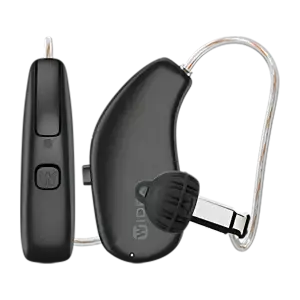
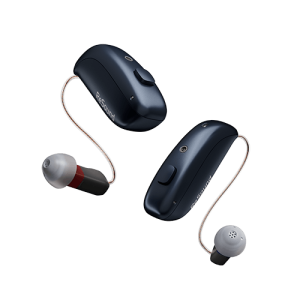
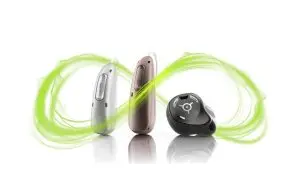
This is precisely the problem that modern hearing aid technology, and specifically the idea of ReSound’s Wide Dynamic Range Compression (WDRC), is designed to address. A well-fitted hearing aid attempts to do what the damaged outer hair cells no longer can: boost soft sounds into the audible range, leave moderate sounds relatively untouched, and gently limit loud sounds to prevent discomfort.
The goal is not simply more volume. It is the restoration of dynamic range, putting back the full spectrum of soft-to-loud, that makes sound feel natural, speech feel clear, and environments feel manageable rather than overwhelming.
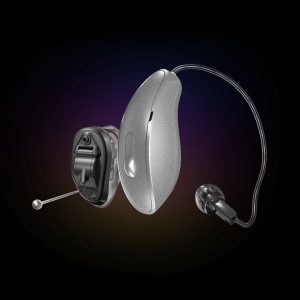
Done well, with a careful fitting based on real-ear measurement, a modern hearing aid can go a long way toward restoring the experience your cochlea used to provide automatically. Not perfectly as what is perfect, and so no one device fully replicates 12,000 healthy outer hair cells, but meaningfully, and for most people, life-changingly. Widex hearing aid processing allows for a wide range of input into their circuit and is why many Musicians enjoy the Widex sound.
The Takeaway (Delivered at a Reasonable Volume)
Your ears are extraordinary. The cochlea’s ability to compress a 140-decibel range of sound into a clear, nuanced, instantly interpretable signal, without batteries (haha), and while you are also trying to remember where you left your keys, is one of the genuine wonders of human biology.
When that system is working perfectly, you never notice it. You just hear the bird, and then you hear the cabinet slam, and your brain moves on without comment.
When your hearing abilities begin to fail, the world gets harder, not just louder or quieter, but flatter. Less detailed. More effortful. Like you are listening to Minnesotans all the time! Now who would want that?
Understanding why that happens is the first step toward doing something about it.
And if you happen to be a Minnesotan who has been peacefully operating within a 6-decibel dynamic range your entire life and never put much stress on your outer hair cells, well, good for you. Your cochlea thanks you.
The New Yorkers among us may need to book an appointment.
Have questions about your hearing, dynamic range compression, or why your hearing aids sound the way they do? Contact our office. We promise to explain everything at a very reasonable volume.