Being told you have hearing loss can feel overwhelming at first. The good news is that once you understand what kind of hearing loss you have, it can make it easier to manage. Not all hearing loss is the same, and each type affects how you hear everyday sounds in different ways.
Let’s break down some of the most common types of hearing loss and how understanding the different types of hearing loss can help you.
Conductive Hearing Loss
What it means: Sound is having trouble getting through the outer or middle ear and the hearing loss is not being caused by nerve or inner ear damage.
Common causes: Earwax buildup, fluid in the ear, ear infections, issues with the eardrum or middle ear bones, perforations in the eardrum, etc.
Real-life example: It may feel like you’re hearing everything “through a wall” or like your ears are plugged after swimming or flying. Voices sound muffled, but not necessarily unclear.
How hearing aids help: Some causes of conductive hearing loss are easily solved, like removing ear wax or taking an antibiotic for an ear infection. Other causes such as disarticulation of the middle ear bones or perforations in the eardrum are more difficult to solve. Sometimes they can be solved through surgery or other medical treatment. If that is not possible, hearing aids can help manage this by bringing sounds up to a comfortable, audible level.
What a conductive hearing loss looks like on an audiogram:
- The bone conduction test results are at a normal level (0 – 20dB), while the air conduction results show a moderate sloping loss. The difference in results (called an air-bone gap) shows a conductive loss.

Sensorineural Hearing Loss (SNHL)
What it means: This is the most common type and involves damage to the inner ear (cochlea) or hearing nerve.
Real-life example: You might hear people talking but struggle to understand them, especially in noisy places. Words may sound garbled or unclear.
How hearing aids help: Modern hearing aids don’t just make things louder, they help clarify speech and reduce background noise, making conversations easier to follow. Ideally hearing aids should give both audibility and clarity to the wearer.
Below we will outline some typical presentations of SNHL:
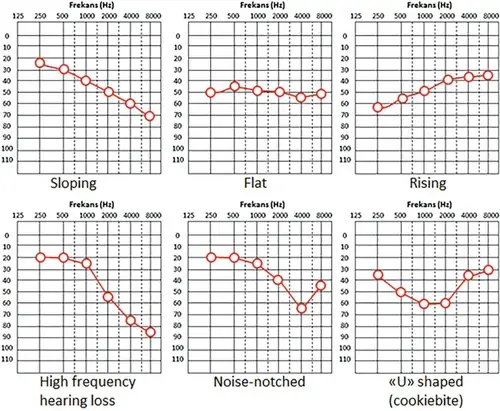
Sloping Hearing Loss
What it means: Low pitched sounds might fall within a normal range, but high frequency sounds drop off. Sometimes low frequency sounds may also fall below normal, but the overall hearing loss will worsen over the high frequencies.
Real-life example:
- You hear vowels (like “ah” and “oh”) but miss consonants (like “s,” “f,” or “th”)
- People may sound like they’re mumbling
- Children’s or women’s voices may be harder to understand than men’s voices
How hearing aids help: Hearing aids can specifically boost those high-pitched sounds you’re missing, making speech much clearer without over-amplifying lower tones.
What a sloping hearing loss looks like on an audiogram:

Cookie Bite Hearing Loss
What it means: Hearing is better in low and high pitches but worse in the middle frequencies, where most speech sounds are heard. Named because it looks like someone took a “bite” out of the hearing test.
Real-life example:
- You might hear environmental sounds just fine but struggle with conversations
- Speech can sound hollow or incomplete
- You may frequently ask people to repeat themselves, even in quiet settings
How hearing aids help: Hearing aids can target those mid-range frequencies, filling in the “missing pieces” of speech so conversations feel more natural.
What a cookie bite looks like on an audiogram:

Reverse Slope Hearing Loss
What it means: You hear high-pitched sounds better than low-pitched ones (the opposite of the more common pattern).
Real-life example:
- Men’s voices may sound faint or hard to understand
- You may hear birds chirping clearly but struggle with deeper voices or background rumble
- Speech can sound thin or lacking fullness
How hearing aids help: Hearing aids can amplify low-frequency sounds, helping balance what you hear and making voices sound fuller and more natural. Reverse slopes can be a more difficult hearing loss to fit. If the hearing aids are over-amplifying the low frequencies it may mask the high frequency sounds and make everything sound less clear overall.
What a reverse slope looks like on an audiogram:

Noise-Notch Hearing Loss
What it means: Hearing is relatively normal at low and mid frequencies, then sharply drops at 3,000–6,000 Hz (most classically at 4,000 Hz), before partially recovering again at 8,000 Hz. This distinctive “V” or notch shape is the hallmark of noise-induced hearing loss. Years of exposure to loud machinery, firearms, concerts, or earbuds at high volume gradually destroy the delicate hair cells in this region.
Real-life example:
- Because the notch sits right in the frequency range most critical for speech clarity, consonant sounds like “f”, “sh”, are especially difficult
- Conversations in quiet may seem fine, but in background noise (a restaurant, a family gathering) speech becomes muddled and effortful.
- This type of hearing loss can often be accompanied by tinnitus
How hearing aids help: Hearing aids are well-suited for noise-notch hearing loss as they can target the specific missing frequencies. Many hearing aids also include directional microphone technology and advanced noise reduction algorithms, which are especially effective for the “I can hear but can’t understand in noise” complaint so common with this pattern.
What a noise-notch audiogram looks like:

Flat Hearing Loss
What it means: A flat audiogram shows roughly equal hearing loss across all frequencies. Flat audiograms are associated with a variety of causes, including genetic/hereditary hearing loss, Meniere’s disease, autoimmune inner ear disease, sudden sensorineural hearing loss, and certain ototoxic medications.
Real-life example: Because all frequencies are reduced somewhat equally, a person with a flat hearing loss experiences the world as if the volume has been turned down uniformly.
- May struggle to hear someone calling your name from another room
- Miss the TV at normal volumes, or find phone conversations consistently difficult
- The evenness of the loss can sometimes cause it to go unrecognized for a long time, since there’s no striking “gap” in what you can and cannot hear
How hearing aids can help: Flat audiograms respond very well to hearing aids. Because amplification is needed fairly evenly across the frequency range, the programming is often more straightforward. Hearing aids can restore that “turned down volume” sensation by bringing all frequencies back up to audible levels simultaneously. Therefore usually resulting in a natural, balanced sound quality.
What a flat loss looks like on an audiogram:

Corner Audiogram
What it means: On the audiogram chart, responses only appear in the bottom-left “corner”. The mid and high frequencies are either profoundly reduced or absent entirely. This pattern indicates that a person has only a small island of residual, functional hearing remaining.
Real-life example: A person with a corner audiogram might perceive that someone is talking because they sense the low-frequency rhythm of speech, but cannot make out a single word. They may hear thunder but not a doorbell, a foghorn but not a ringing phone.
How hearing aids help: Traditional hearing aids offer limited benefit for a corner audiogram, since there is very little residual hearing to amplify into. They won’t restore normal hearing, but can provide additional sound awareness and environmental cues. For many people with this hearing loss, a cochlear implant evaluation is recommended.
What a corner audiogram looks like:

Mixed Hearing Loss
What it means: A combination of conductive and sensorineural hearing loss.
Real-life example: You might experience both muffled sound and difficulty understanding speech clearly, like hearing is both blocked and distorted at the same time.
How hearing aids help: Hearing aids can address the sensorineural portion, while medical treatment may improve the conductive component. If medical treatment is not possible, hearing aids will still help increase the audibility and clarity.
What a mixed loss looks like on an audiogram:

Why Understanding Your Hearing Loss Matters
Understanding your hearing loss helps you understand where and why you might struggle most with your hearing. Not every hearing loss looks and functions the same way. Someone who has a sloping high-frequency loss will likely have difficulty in different ways than someone with a conductive loss. Understanding your hearing test and particular hearing loss can give you the tools to advocate for yourself. The biggest takeaway is to give yourself grace and remember that you are not alone.
Final Thoughts
If you’ve recently been diagnosed with hearing loss, you’re not without options. Understanding your specific type of hearing loss is the first step toward better hearing and better communication.
If you’re unsure which type you have or what your next steps should be, a hearing care professional can walk you through your results and help you find the best solution for your lifestyle. If you have any questions feel free to contact us. Or schedule an online consultation for a more in-depth conversation about your hearing loss and tools and solutions available to you.